
this is a case study style breakdown.
not “what yield protocols are”.
not “how defi works”.
you’re a founder.
you’re building a yield product.
you’re asking: how do i actually get this off the ground and make it investible?
this is the answer.
first: what kind of yield protocol are you, really?
before GTM, before TVL, before tokens.
you need to be honest about where the yield comes from.
everything else flows from this.
there are two buckets. no third one.
bucket 1: synthetic / onchain-native yield
yield comes from:
leverage
basis trades
delta-neutral strategies
rebalancing
aggregators
“strategy sauce”
smart contract plumbing
aka: magic internet money (even if it’s well engineered).
in this bucket:
nobody cares how clever it is
nobody cares about your architecture
nobody cares about your vision
they care about one thing:
how much do i make, and for how long?
that’s it.
bucket 2: yield backed by something offchain (RWA)
yield comes from:
credit
treasuries
real businesses
real cashflows
real-world risk
still, yield matters most.
but now there’s a second question:
why should i do this through you, and not directly?
this is where most RWA protocols die.
because they forget they’re not the asset.
they’re the intermediary.
the universal truth (for both buckets)
yield protocols live and die by TVL.
not users.
not followers.
not impressions.
TVL is:
your market signal
your investor signal
your survival metric
you can have:
great UX
clean contracts
clever strategies
and still never cross $2m TVL.
that’s the graveyard.
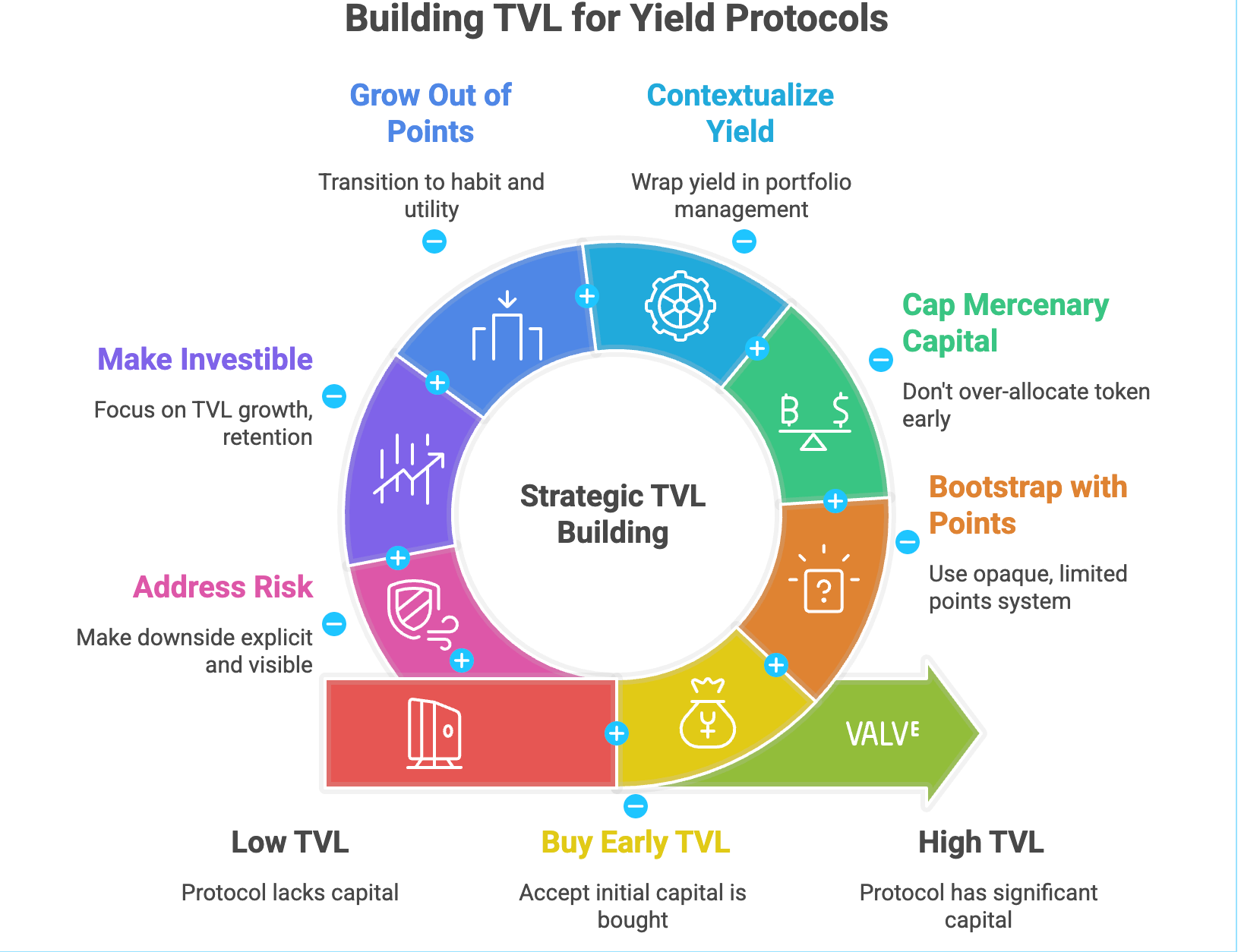
so how do you actually build TVL?
this is the sequence we’ve seen work.
not theory. practice.
step 1: accept that early TVL is bought, not earned
early TVL is not “organic”.
it comes from:
incentives
deals
private conversations
risk-reward asymmetry
pretending otherwise is cosplay.
the mistake is not using incentives.
the mistake is using them blindly.
step 2: decide what kind of capital you want
there are two types of money coming in early:
1) mercenary / institutional LPs
large checks
fast
ruthless
leave when incentives dry up
2) retail / long-tail users
smaller tickets
slower
sticky if narrative makes sense
your job is not to avoid mercenary capital.
your job is to cap it.
rule of thumb:
if >60-70% of your TVL can leave in a week, you don’t have TVL. you have a timer.
step 3: bootstrap TVL with a non-public points system
yes, points.
no, not the stupid version.
what works:
points only for LPs
no social tasks
no public leaderboard
no “post and earn”
no clear formula
rough guidance only:
“longer stays > more points”
“bigger capital > diminishing returns”
“early participation > bonus”
farmers optimize clarity.
remove clarity.
step 4: don’t blow your token allocation early
most yield protocols self-sabotage here.
common mistake:
massive points allocation
high implied FDV
token dumps at TGE
LPs leave
death spiral
early incentives should:
buy time
not define your entire cap table
if your protocol needs 30-40% of supply just to exist, it doesn’t work.
step 5: if you’re RWA, answer the real question
for RWA-backed yield, this matters more than APR.
investors and LPs will ask (explicitly or not):
why shouldn’t i do this deal myself?
your answer can’t be “because crypto”.
good answers look like:
access (they can’t get this deal otherwise)
aggregation (you bundle fragmented opportunities)
ops (you manage complexity they don’t want)
scale (ticket sizes don’t fit them individually)
speed (onchain rails beat legacy workflows)
bad answers look like:
vibes
“tokenization”
dashboards
buzzwords
you are selling convenience + access, not yield alone.
step 6: contextualize the yield
nobody wakes up thinking:
“i want yield”
they think:
“i want my money to work”
“i want stability”
“i want predictable income”
“i want exposure without headache”
successful yield protocols wrap yield inside:
portfolio management
treasury management
neobank-like UX
wealth tooling
specific narratives (real estate, credit, etc.)
yield is the engine.
context is the interface.
step 7: grow out of points, don’t stack them forever
points are scaffolding.
if you’re still dependent on them after:
6-9 months
product maturity
clear PMF signals
you have a problem.
long-term stickiness comes from:
habit
utility
reinvestment loops
trust
not emissions.
step 8: make it investible, not just fundable
fundable:
hype
trend
narrative
timing
investible:
TVL growth curve
capital composition
retention
yield sustainability
clear downside analysis
investors who matter will always ask:
“what happens if growth slows?”
you need an answer that’s not “we emit more”.
step 9: the risk question nobody wants to answer
“what happens if this breaks?”
for anyone deploying size, the real fear isn’t volatility.
it’s principal loss with no clear downside framework.
RWA-backed yield, credit-like structures, and anything touching real cashflows all carry real failure modes:
defaults
counterparties blowing up
legal or jurisdictional issues
hand-waving that away caps your TVL by design.
for example, @SpiceProtocol
is operating a shared coverage layers that let yield markets plug into a common protection standard, instead of everyone duct-taping their own solution.
the point is that if you’re building yield and you don’t make downside explicit and visible, your TVL ceiling is lower than you think.
either you build a real risk layer, or you integrate one early.
the real bottleneck
the hardest part is not:
contracts
audits
dashboards
it’s convincing people to park real money with you.
and they don’t do that because you’re clever.
they do it because the tradeoff makes sense.
TL;DR
yield protocols are judged on TVL, nothing else
first identify where your yield comes from
synthetic yield = pure numbers game
RWA yield = trust + access game
early TVL is bought, not earned
points can work if opaque and limited
mercenary capital must be capped
context beats raw APR
points are scaffolding, not a foundation
investible > fundable
this isn’t about being flashy.
it’s about not dying quietly at $1.8m TVL.
back to work.